Do Rejection Streaks Hurt Individual Sales Performance? What The Data Says
AI & Data, Operations
What 900,000 car wash sales presentations suggest about rejection fatigue, momentum, and where coaching actually works.
You would think that if a salesperson goes through a string of rejections (let’s say 10 in a row) that their subsequent conversion rate would slip below their baseline. Let’s call it rejection fatigue. And if that’s the case perhaps we should create some interventions when we see a salesperson dip into that pattern. So I decided to test it.
I looked at a dataset of 900,000 membership pitches from a little over 3,000 salespeople. I was looking at their conversion rate after a string of rejections. Initially, it seemed to prove true. If you chart conversion rate against length of the rejection streak, the drop in conversion rate is clear. The longer the streak, the lower the conversion. By the time you get into deeper runs, performance looks dramatically worse than baseline.
But that’s not what’s actually happening.
What that view is capturing isn’t a single salesperson getting worse post-rejection streak. When I looked closer, lower-performing salespeople naturally accumulate longer streaks because they convert less often. However, higher-performing salespeople reset streaks more often. So as you move deeper into a streak, you’re increasingly looking at a different group of people—not the same person deteriorating.
When you control for that—when you compare each salesperson to their own baseline—the drop in conversion post-rejection streak disappears.
The same person at a streak of ten rejections performs about the same as they do at a streak of two. No meaningful degradation. It appears rejection fatigue is not supported in the data.
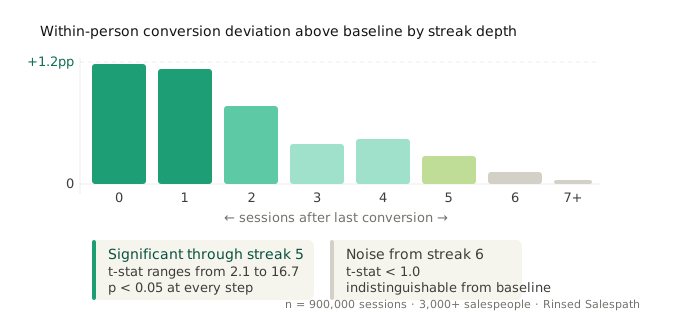
However, I did uncover a very real streak effect, but surprisingly in the other direction.
Right after a conversion, performance improves.
In the 2-3 interactions after a conversion, the salesperson converts at 10% above their baseline. This wasn't one or two outliers. It held across the entire data set of more than 3,000 salespeople.
“The only consistent change in performance isn’t after failure. It’s after success.”
So let’s think of the real world. Let’s say Mary’s conversion rate is typically 12%. There is a set of baseline behaviors that lead to that 12%. What shapes those are her training, her coaching, her people skills, her discipline, her desire to make more commission, etc. When she faces a string of rejections, the data tells us that those behaviors remain almost entirely intact.
But that also applies to Joe who has a baseline conversion rate of 5%. Joe’s set of behaviors will also remain intact after a string of rejections.
But what is fascinating is that both Mary and Joe will get better after a successful conversion. Their behaviors change a bit and they rise above baseline. It makes perfect sense and it reveals something about what goes into high performance. After a conversion, everyone feels just a little more confident. They’re in a little better mood. The energy is just a little higher.
The next customer or two feels that confidence, mood, and energy—and it leads to a higher likelihood of converting.
Joe's underperformance isn't a streak problem. It's a baseline problem. And that requires a different intervention entirely.
The financial consequences of this are real. At actual membership lifetime value, that's roughly $80,000 in additional customer value per location—from the same cars, the same team, one behavioral shift.
The takeaway is simple. I often talk about coaching as being part correction, part celebration. This finding emphasizes the celebration side. Ask yourself: what does your culture do to extend the energy of a win? The data shows exactly what happens when a salesperson feels confident, brings the energy, and carries that into the next interaction.
The only consistent shift in behavior isn't after failure.
It's after success.